P0 · 9 min read · 2026-10-23
One game character, five style directions: plan a DLSS 5-style comparison matrix
A game character style test needs one unchanged source and explicit creative variables. Compare light, material and palette separately, then reject identity drift before choosing a favorite.
DLSS 5 · game character
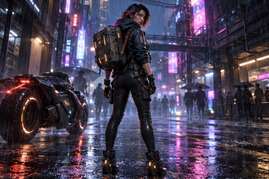
A game character style test needs one unchanged source and explicit creative variables. Compare light, material and palette separately, then reject identity drift before choosing a favorite. This guide proposes five directions; it does not claim five completed generations.
TL;DR
- Keep the character source, intended pose, costume and camera brief unchanged across the matrix.
- Use cyberpunk, fantasy, science fiction, anime and realistic treatment as proposed directions, not interchangeable labels for five verified outputs.
- Start each attempt from the original source, rather than feeding one altered character into the next direction.
- The illustrated pair is a historical site-owned example. A helmet replacing visible hair makes it unsuitable for a brief that protects that hair.
Why this question belongs beside DLSS 5
DLSS 5 brings game appearance and artistic intent into the same discussion. NVIDIA's research overview places the technology within a game-rendering pipeline. The independent still-image workflow discussed here does not execute that runtime and cannot establish its behavior.
Our practical question is narrower: how can a creator compare DLSS 5-style visual references for a game character without losing the original design? Studio is the product and handover context. The matrix is a way to organize creative review, not a hardware benchmark, compatibility test or promise of real-time game rendering.
A game character style gallery of unrelated characters does not answer the same-character question. A knight, a firefighter and an anime heroine may illustrate different directions, but they also change the subject. If you want to decide how your character should look, those changes prevent a fair visual comparison. Keep the source fixed so disagreements can be traced to a proposed treatment.
Define the common source and the rejection conditions
Before writing any style request, identify the features that carry the character. Include head shape, exposed hair, costume construction, stance and equipment. State which parts cannot be inspected from the source. A hidden face should remain an unknown, rather than becoming a confidently approved face in the result.
Also separate the character from the scene. A rainy street can help describe illumination, but it need not authorize a redesigned helmet or weapon. If changing the background is part of the assignment, say so. Otherwise, a dramatic environment may distract reviewers from the more important question of whether the person remains recognizable.
For this source, one possible invariant is that the visible hair must not be replaced by headgear. This is an editorial acceptance condition, not a recovered instruction from a new test. You can choose a different condition for a different assignment, but choose it before looking at the candidate results.
The five-direction planning matrix
The following rows are suggested briefs. None is presented as a new measured output. The names match directions discussed on the site's character page; the matrix is not an automatic batch feature or a claim that the interface contains these exact preset buttons.
| Direction | Light to investigate | Material treatment to investigate | Palette question | Keep checking |
|---|---|---|---|---|
| Cyberpunk | Colored edge light and reflected street light | Relationship between cloth and reflective fittings | Can colored accents stay subordinate to the character? | Exposed hair, costume edges, equipment shape |
| Fantasy | A warm or cool dramatic source with readable shadows | Cloth, leather and metal as distinct surfaces | Does a restrained accent identify the protagonist? | No invented armor or changed silhouette |
| Science fiction | Controlled directional light on existing equipment | A cleaner treatment of the existing surfaces | Can a cooler palette work without erasing costume cues? | No new visor, helmet or mechanical limb |
| Anime | Grouped light and shadow shapes | Simplified surface detail rather than added objects | Do color blocks preserve the costume's organization? | Facial arrangement, hair outline and garment divisions |
| Realistic | More natural-looking light relationships | Plausible surface response on the existing design | Does the scene remain readable with quieter accents? | No replacement face or redesign disguised as realism |
These columns turn style labels into questions. They do not claim that fantasy always uses warm light or science fiction always uses cool colors. You are selecting a particular treatment to compare, not defining every possible example of a genre. Change the proposal when it does not match the game world's art direction.
Change one review question before changing the whole world
A five-direction comparison can become impossible to read if every row changes camera, pose, costume, environment and light at once. Start with a restrained pass in which the main question is lighting. If a direction remains interesting and preserves the character, discuss a material or palette variation separately.
This is a recommended way to make comparisons interpretable. It is not a claim that fewer words or fewer variables improve a model by a measured amount. The point is to help a human identify why a result is accepted or rejected. A complicated request may be legitimate, but its outcome should not be described as isolating one cause.
Keep the invariant portion of the brief identical. Put the proposed creative difference in a separate sentence. Reuse the untouched source for each attempt, so a helmet accidentally introduced in an early result does not become the starting identity for later rows. This prevents a procedural mix-up; it does not guarantee that a new attempt will retain the source correctly.
What the existing result contributes
The historical result below shares the source's neon-street subject but changes the head treatment. The source shows hair; the result has a helmet. Its more elaborate presentation therefore cannot establish that the character passed an exposed-hair requirement. This is a visible reason to stop accepting that candidate for identity-specific use.
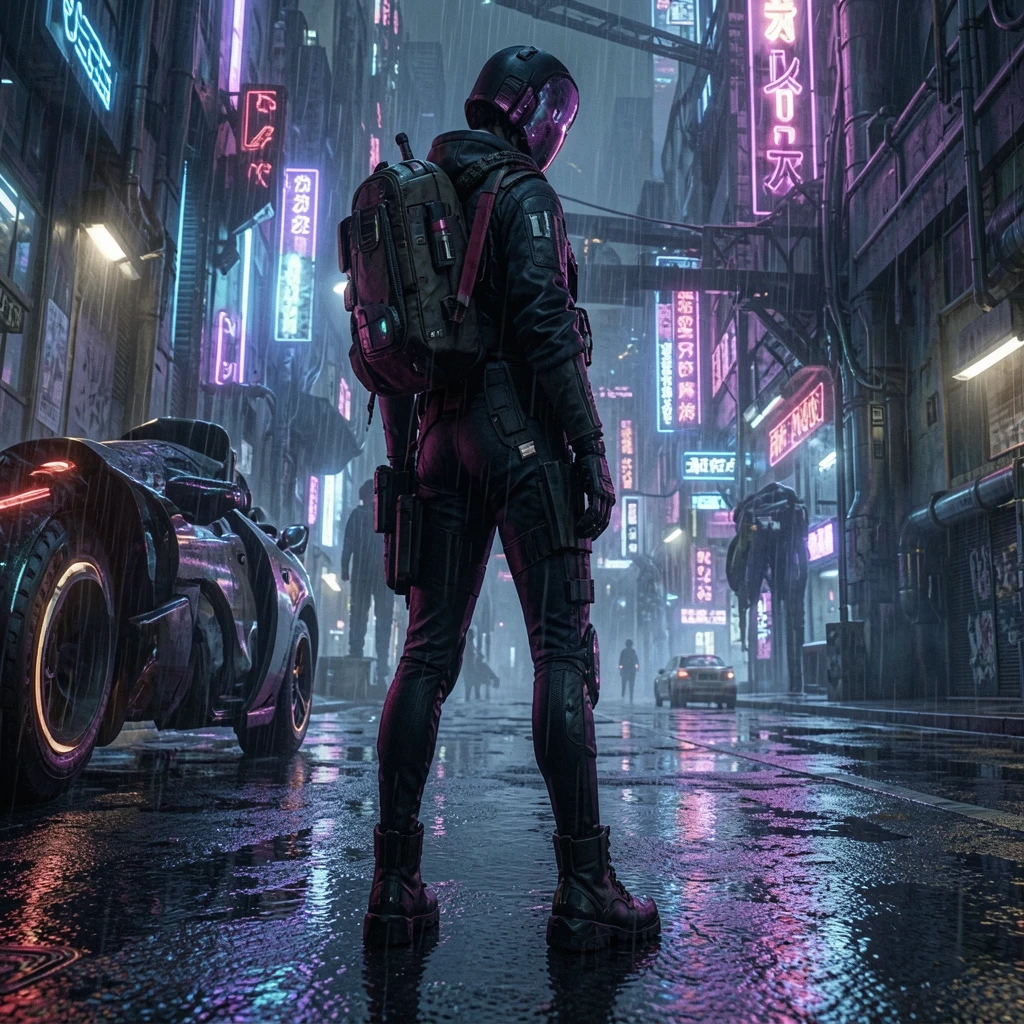
This pair demonstrates how to fill an acceptance note, not how to select a winning genre. Write that the head condition failed, the face comparison is unresolved, and the lighting can be considered separately. Do not invent ratings for the other directions. Unrun rows should remain unrun, even when a complete-looking table would be more persuasive.
A manual procedure for a future style-direction test
- Save the original character image and write the invariant brief before opening a new attempt.
- Choose a row from the matrix and identify the main variable you want to investigate.
- In the character-editing workflow, use the original source and describe that direction alongside the same invariants. Follow the current sign-in and usage requirements for your own image.
- Wait for the actual result or failure state. Do not treat an unfinished attempt as an empty success.
- Compare the candidate with the original, then record what is retained, changed or unclear.
- Return to the same original source before attempting the next direction. Keep failed candidates distinguishable from accepted references.
This sequence is a proposed workflow, not a report of runs performed for this draft. We supply no new task parameters, timing range or output dimensions. BFL's image-editing documentation provides background on text-and-image editing; it does not validate our proposed matrix or guarantee its constraints.
The free cached example also has a narrower role. It lets a reader inspect an existing example, not launch an unlimited matrix of new images without an account. Do not confuse choosing a planning row with actually submitting a new task. If the current interface cannot express a desired control, note the limitation instead of claiming it was set.
Compare outcomes without hiding the failures
Review identity before aesthetic preference. Then compare the selected visual dimension: where the light falls, how existing surfaces are treated, or which colors organize the figure. A row can be useful for lighting while failing costume fidelity. Label that limited use explicitly instead of converting every attractive candidate into an overall pass.
Avoid averaging away a critical failure. A strong atmosphere does not compensate for a changed face when the assignment requires the same face. Likewise, a recognizable silhouette does not prove that small equipment or text remains accurate. Let the brief decide which failure blocks use, rather than calculating a flattering score after the fact.
When to stop and what to hand over
Stop a direction when it repeatedly conflicts with a protected identity feature, when the source is too ambiguous to judge, or when the next variation has no clear decision to answer. These are recommended stopping conditions, not observed failure frequencies. A team should set its practical attempt limit before spending time or usage allowance.
An acceptable endpoint can be one useful visual direction with specific unresolved details. It need not be five finished winners. Hand over the original, the candidate and a short acceptance explanation so that the next artist knows whether they are reviewing lighting, costume or a complete character concept.
For the preservation criteria, read the existing character-consistency guide. The game-character style tool is the corresponding workflow entry. Game character style exploration remains a creative review task, not proof that a manufacturer runtime processed these images.
Disclosure
We operate the linked site independently and are not affiliated with NVIDIA or Black Forest Labs. The pictures are authorized site-owned historical samples. No fresh five-direction experiment, game integration, temporal test or hardware measurement was performed for this article. The matrix is ready to guide a future comparison, with its untested rows stated plainly.
Try the free AI image tool · Check the source-linked GPU evidence