P0 · 7 min read · September 18, 2026
DLSS 5 and GPT-6 Astra: How Neural Rendering and Reasoning Models Fit Together
A source-led explanation of what GPT-6 Astra can orchestrate around DLSS 5, what DLSS 5 actually renders, and how to design a verifiable AI rendering workflow.
dlss 5 · gpt-6 astra · ai rendering workflow · neural rendering
TL;DR
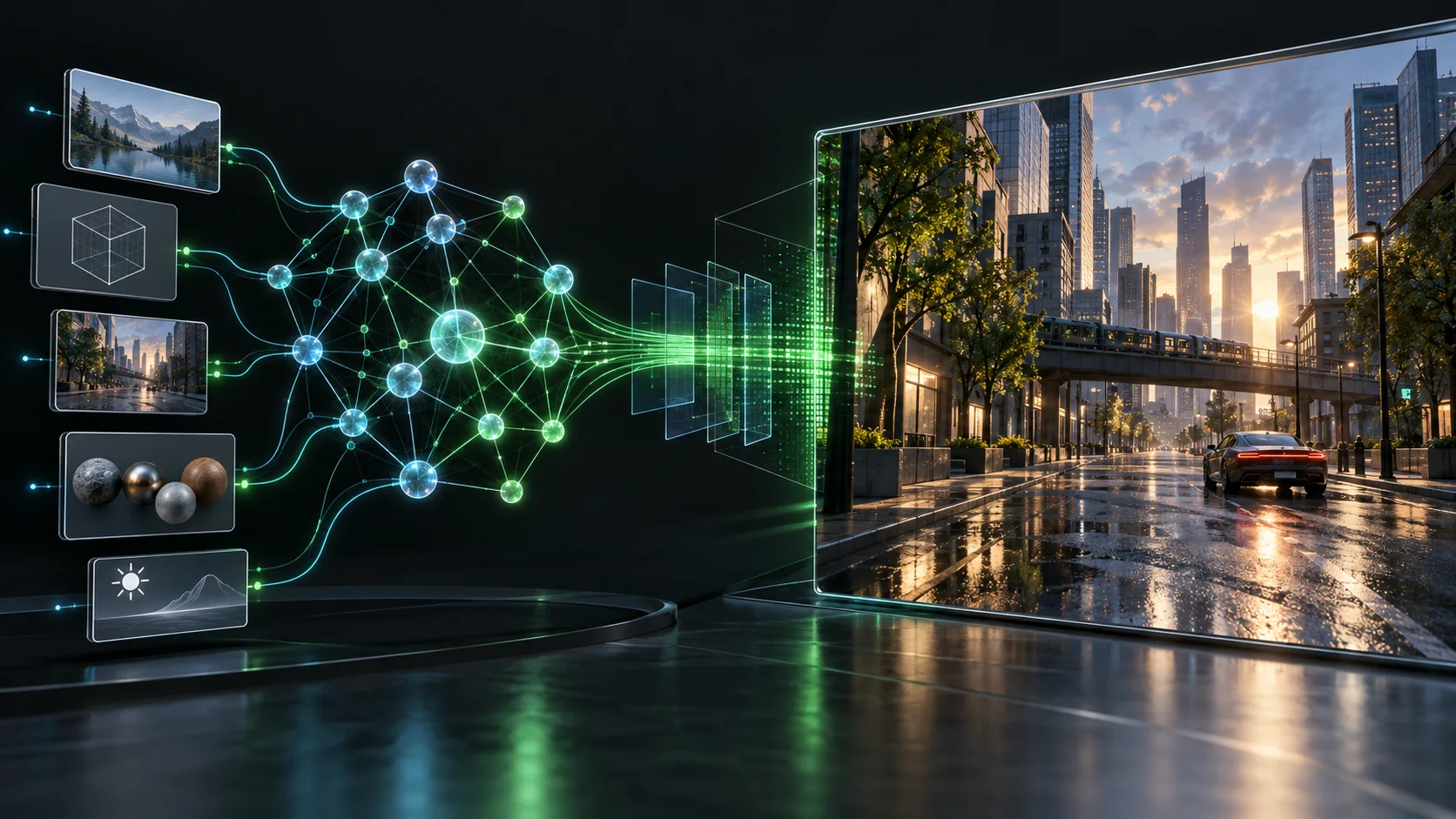
GPT-6 Astra and DLSS 5 are complementary layers, not interchangeable models. GPT-6 Astra can understand a goal, inspect text and image inputs, produce a structured rendering brief, and run quality checks. DLSS 5 is a local, real-time rendering stage inside supported game pipelines on GeForce RTX 50 Series GPUs. It receives game-rendering signals and generates the final appearance; it is not a general-purpose prompt API.
The practical architecture is: GPT-6 Astra for intent, planning and evaluation → the game engine for scene state → DLSS 5 for grounded real-time appearance. For a browser image tool, the equivalent keeps the planning model separate from the image-generation or enhancement provider.
What has actually been announced
NVIDIA describes DLSS 5 as a real-time generative rendering stage that runs locally in existing game pipelines on RTX 50 Series GPUs. Its research page says it generates the final displayed appearance rather than reconstructing a higher-cost reference output from a conventional renderer. NVIDIA also describes 3D-Guided Neural Rendering as AI that adds lifelike lighting and materials while being tuned by developers for each game.
OpenAI describes GPT-6 Astra as a general reasoning model available through the API with the model ID gpt-6-astra. The API catalogue lists text and image input and tool use for the latest models. That makes Astra useful for planning and verification, but the OpenAI announcement does not say GPT-6 Astra directly calls or replaces DLSS 5.
The right division of work
| Layer | Responsible system | Output |
|---|---|---|
| Intent | GPT-6 Astra | Structured goal, constraints and acceptance checks |
| Scene state | Game engine | Color, motion vectors and object metadata |
| Appearance | DLSS 5 | Real-time, temporally grounded lighting and materials |
| Review | GPT-6 Astra plus deterministic checks | A report on framing, objects, text and artifacts |
This separation prevents a language model from rewriting the scene after the engine has rendered it. The model should return a typed plan with limits, not an unrestricted replacement for the scene graph.
A concrete GPT-6 plus neural rendering workflow
1. Normalize the request
GPT-6 Astra can turn “make the neon street feel wetter at night” into a brief: preserve camera transform, preserve object IDs, increase wet-surface reflection, keep signage text unchanged, and target a frame budget. The renderer should receive only fields that the integration supports.
2. Validate before rendering
Reject requests that modify protected assets, change a character identity, bypass safety controls or exceed a performance budget. Store both the original brief and the normalized plan so a later review can explain what changed.
3. Keep rendering grounded
DLSS 5's value is its connection to color, motion and 3D scene data. GPT-6 should not invent those signals. It can choose a supported preset or explain a result, while the engine and DLSS integration remain responsible for frame-to-frame consistency.
4. Review with evidence
Use deterministic checks for dimensions, frame timing and metadata. Use a vision-capable model for a second-pass report on changed text, missing objects or unstable faces. Always show an input/output comparison; a model's “looks correct” answer is not proof of fidelity.
What this means for browser image tools
A browser tool cannot turn a server-side image model into DLSS 5. It can use the same separation of concerns: GPT-6 Astra can normalize a request and create a constrained prompt; the image provider executes the edit; the server enforces aspect ratio and output limits; and the UI shows a geometry-preserving comparison before download.
Our current browser product uses an AlphaNet-compatible image backend for execution. GPT-6 Astra is a possible future orchestration layer; it should not be marketed as DLSS 5 or as a direct DLSS runtime.
Frequently asked questions
Can GPT-6 Astra call DLSS 5 directly?
There is no public NVIDIA or OpenAI announcement of a direct GPT-6-to-DLSS 5 API. A real integration would need a game or rendering application to expose a supported control surface, while DLSS 5 continues to run in the local RTX 50 Series pipeline.
Is DLSS 5 the same as GPT image generation?
No. DLSS 5 is grounded in a real-time game scene and temporal signals. A general image model starts from an image or text request and may synthesize new content. They solve different problems and require different tests.
Editorial note: this article separates confirmed product behavior from a proposed integration pattern. It does not claim that DLSS 5 and GPT-6 Astra are currently bundled together.
This site is independent and is not affiliated with or endorsed by NVIDIA Corporation or OpenAI.