P1 · Source-led guide · 2026-10-23
Reading an Aiarty image enhancer review: reproduce the comparison before trusting the detail
Keep the input, record the settings, and inspect matching regions before accepting an enhancement claim. A convincing after image can demonstrate a useful edit without proving that missing detail was recovered.
image workflow · entry-point
Keep the input, record the settings, and inspect matching regions before accepting an enhancement claim. A convincing after image can demonstrate a useful edit without proving that missing detail was recovered.
DLSS 5 Studio turns existing images into DLSS 5-style visual references through style conversion and neural-render redraw, with the desktop app as the handover. This review-method article covers only a limited entry point for poor-quality existing pictures; its kitchen example leads back to room style conversion, not a claim that sharpening is the product.
TL;DR
- Save original bytes, output bytes, settings, and provenance.
- Separate an attractive redraw from a reconstruction supported by a reference.
- Inspect edges, texture, text, and identity independently.
- Our demonstration retrieves a cached kitchen redraw; it is not an Aiarty test.
Keep these notes with the files
- Input record: file hash, ownership, and whether a reference exists.
- Operation record: prompt, parameters, cache state, and returned file.
- Observation record: named regions, visible changes, and unresolved questions.
What prompted this guide
RedShark published its Aiarty article on October 15, 2026, with a Sponsored Article label. That disclosure matters when deciding what kind of evidence the page supplies. We use the article as the reason to discuss comparison methods, without repeating its pricing or performance claims. Read the RedShark article.
Someone searching for an aiarty image enhancer review may want to know whether a beautiful comparison will transfer to their own archive. The useful next step is a small, documented experiment. We have not installed or benchmarked Aiarty, and this guide offers no verdict on its quality. Its user guide is a separate reference for readers who choose to test that product themselves.
Do not infer the ownership of every comparison image from the sponsorship label alone. What matters for your experiment is whether you have the original input, permission to use it, and enough settings to repeat the operation. A web preview without those pieces cannot settle how your photograph will behave.
Start by naming the actual operation
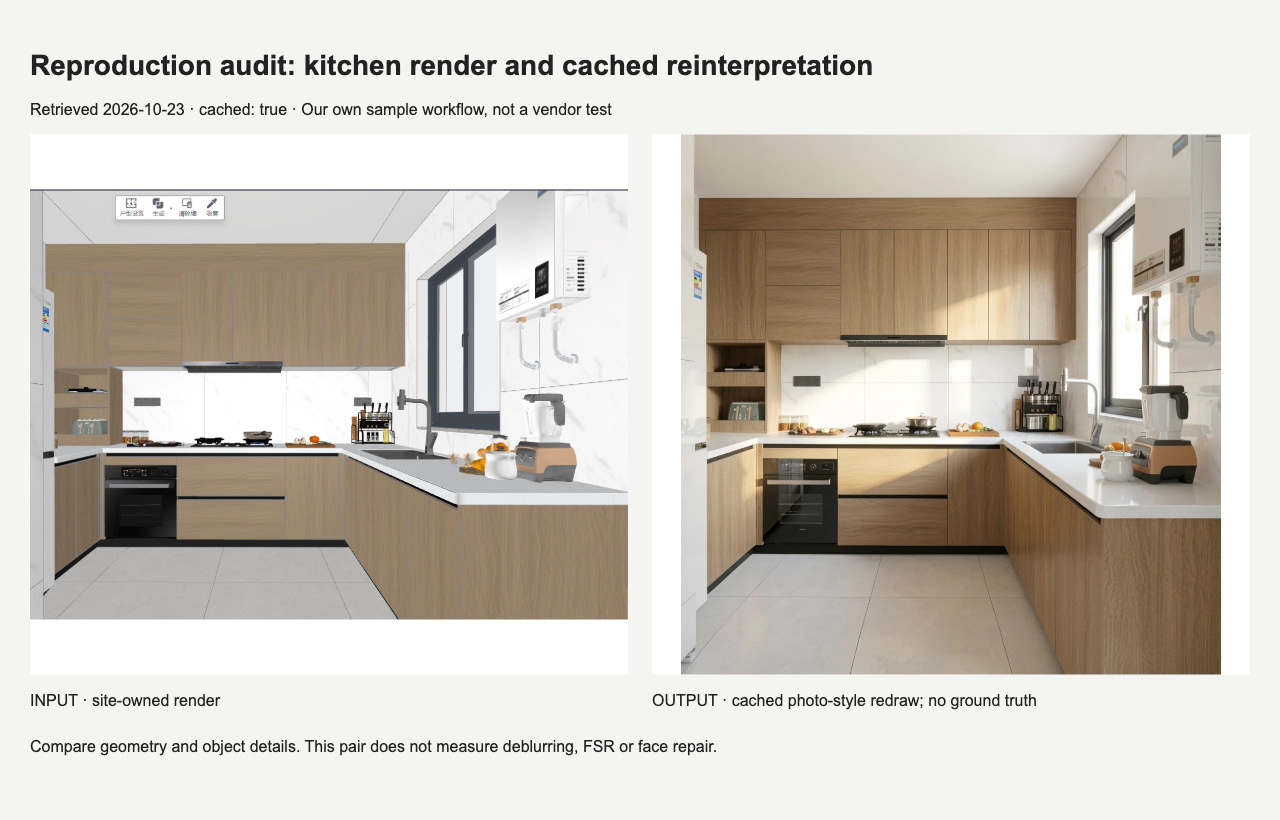
Our own public kitchen example accepts an existing render and asks for a photographic interpretation while keeping the layout. On October 23 we requested that example and received a successful response marked cached: true. We downloaded the input and the stored output, then captured a local inspection page containing both files.
That record establishes a real, repeatable retrieval and a real pair to inspect. It does not establish a fresh inference run, a deblurring result, or a measured restoration score. The input is an interior render, not a deliberately blurred camera original. Those distinctions belong beside the image, where readers will encounter them.
Look for changes the prompt did not make obvious
The pair preserves a recognizable kitchen arrangement, but lighting and surface appearance differ. The input includes a small interface overlay near the upper edge; that overlay is absent in the output. This is a concrete reason to inspect the whole frame even when the intended task sounds limited.
A cleaner-looking wall can be desirable in an illustration. The same change would matter differently in a documented screenshot. Decide which content is allowed to change before seeing the output, so that an appealing result does not quietly rewrite the acceptance criteria.
A reproducible retrieval you can perform
The following commands require curl and a shell. Run them from a new working directory. They request the same public example and preserve the response before downloading the result. No Aiarty installation or account credential is involved.
curl --fail --silent --show-error \
  -H 'Content-Type: application/json' \
  -d '{"sample":"sample1"}' \
  https://www.dlss5nvidia.com/api/image-edit/samples -o run.json
curl --fail --silent --show-error \
  https://www.dlss5nvidia.com/examples/sample1.jpg -o input.jpg
curl --fail --silent --show-error \
  'https://www.dlss5nvidia.com/api/image-edit/samples?sample=sample1' -o result.webp
Read the response before drawing conclusions. Our response states the prompt, the input path, the result path, and the cache flag. If your response is an error or indicates that processing is still underway, stop and record that condition. Do not rename an error document as an image or borrow an unrelated result.
The shipped assets include our response and SHA-256 hashes. A later cache revision could produce different bytes. Matching hashes confirm that you inspected our exact files; different hashes mean you should record a new version of the example. Neither outcome measures whether the model recovers truth.
Keep a reference separate from the input
For a restoration experiment, start with a photograph you own and retain an untouched reference. Make a degraded working copy through a recorded blur, resize, or compression operation. Process only that working copy. Then compare the output with the untouched reference, using the same region and display size.
This controlled exercise asks whether known detail survives a specific degradation and processing chain. An old family scan without an original reference asks a narrower question: whether the edit is useful and whether visible contradictions appear. It cannot reveal every invented feature, because the missing evidence is unavailable.
Four inspection passes that answer different questions
Edges and geometry
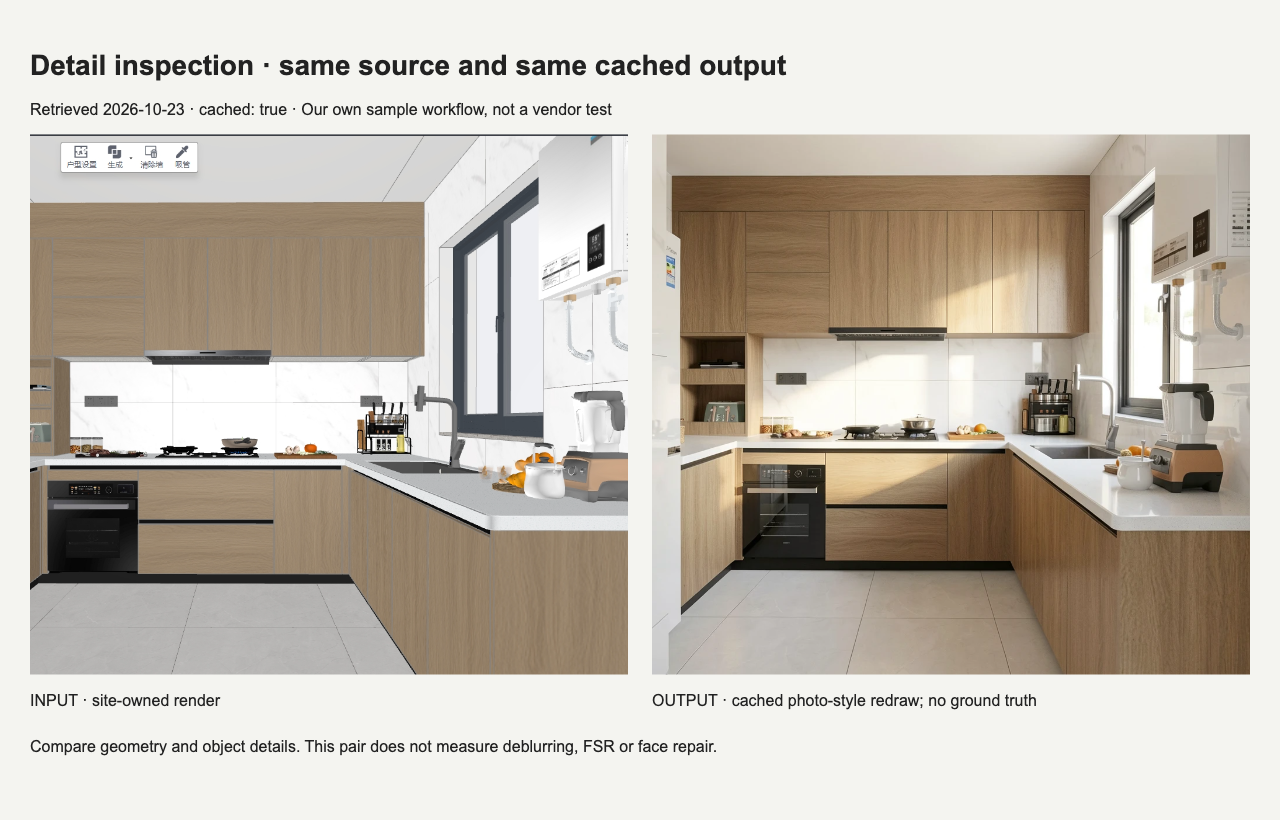
Follow a cabinet seam from one end to the other. Check whether it stays connected, changes direction, doubles, or disappears behind an invented highlight. Inspect the corners of the window and the outline of the tap. Record the location and the change, rather than writing that the entire picture became sharper.
A halo may make an edge easier to notice while also changing its profile. At fit-to-window size, that may look persuasive. At a matched crop, you can judge whether the transition remains acceptable for the intended use. The appropriate conclusion concerns that edge and that display size.
Texture and material
Wood grain is a useful trap for an incautious reviewer. A generated pattern can look plausible while having no correspondence with the input. Look for repeated marks and large changes in direction. Compare the pattern with a real reference if you have one; otherwise describe it as a new surface interpretation.
The same reasoning applies to hair, fabric, grass, and brick. Their familiar structure makes added detail easy to believe. A texture that feels natural supports an aesthetic judgment, but it does not identify the texture that was present when the source was made.
Text and symbols
Read labels character by character against the input. A mark that becomes legible only after generation should remain unverified unless an independent source confirms it. Do not use visual confidence as a transcription method. A realistic-looking serial number can be more misleading than an unreadable original.
Our kitchen scene contains small appliance markings, but we do not claim to recover their wording. That is an intentional limit on interpretation. If your actual task concerns text, choose a source with known wording and keep the acceptance rule strict: changed characters are an error even when the label looks cleaner.
Faces and identity
This sample contains no face, so it provides no evidence about identity preservation. For your own authorized portrait test, inspect eye shape, eyelids, teeth, hairline, and distinctive marks separately. Keep a reference photograph available and ask the person pictured to review edits intended for personal use.
Do not combine these checks into a single beauty score. Someone can prefer the expression while noticing that a distinctive feature has changed. Report both observations. The absence of an obvious error also does not establish that every reconstructed detail is accurate.
Write a result that another reader can audit
A useful note names the task, input, settings, output, inspected regions, and unresolved questions. It distinguishes observation from inference. For our pair, the disappearance of the input overlay is visible; the exact cause of that change inside the model is not established by the files.
Keep failed and ordinary attempts alongside the chosen example. If you select one attractive output from several trials, disclose the selection. If there was only one retrieved cache entry, say that instead. A reader should be able to distinguish a curated illustration from a repeatability experiment.
When reading an aiarty image enhancer review, use the same checklist without demanding that a promotional illustration answer every scientific question. Ask what evidence it actually supplies. A downloadable input supports reproduction; a matching reference supports fidelity checks; a screenshot alone supports a more limited visual inspection.
Try the method on a relevant image
The unblur image page is a starting point for inspecting a soft image of your own. Keep the original and decide whether the goal is readability, presentation, or preservation before processing. Stop if a result changes content that your use requires you to retain.
Our enhancement configuration uses flux-klein to redraw an image, offers target factors of 2× and 4×, and caps each output edge at 1536 pixels with dimensions aligned to multiples of 16. The requested factor can be reduced by that cap. This sample's cached style-conversion request is a separate operation, not a demonstration that those factors were achieved.
A fresh enhancement check alongside the cached example
We also ran the compressed screenshot of this inspection page through flux-klein during this batch. The exact input and completed output are included here; this is the same documented run discussed from a sharing perspective in the companion article. It is not another independent trial.
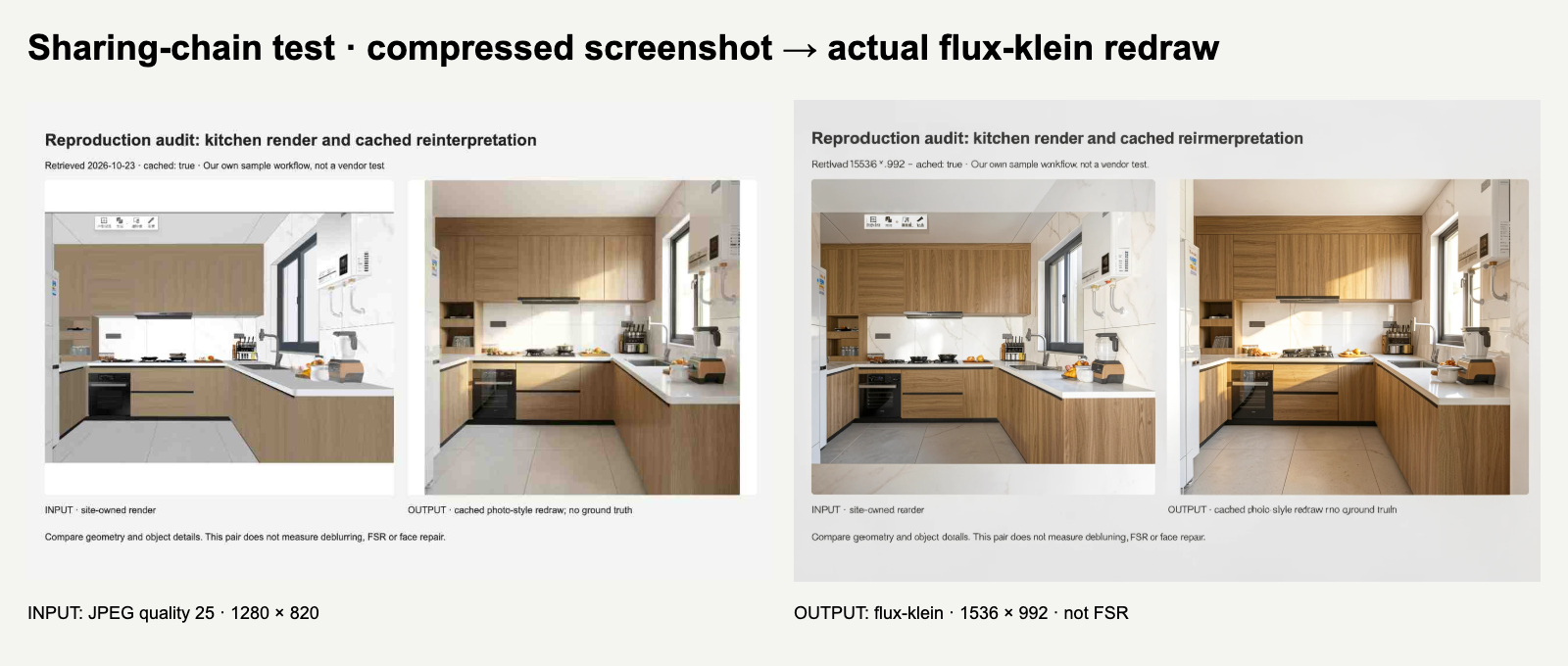
The request and result records let you audit which file was processed. To repeat the check with authorized model access, upload the included compressed JPEG and use the prompt and settings in assets/enhance-request.json; preserve your returned bytes separately. Read the heading against the input before assessing texture. In our saved output, lettering changes, so the result fails an exact-text preservation requirement even if someone prefers its surfaces.
Boundaries and independence
We cannot establish Aiarty's quality from this exercise, recover unseen historical detail, or promise facial reconstruction. The kitchen pair demonstrates a documented redraw and an inspection method; it is not a pixel-exact restoration benchmark. We publish this guide for our own site's readers, so the landing-page link serves our product. We are independent and not affiliated with NVIDIA, AMD, Aiarty, or RedShark.
Related reading
Read the documented style-conversion case · Open the existing-image tool
Try the free AI image tool · Check the source-linked GPU evidence